Ubuntu's Popularity Over the Years
By Luke Miller
- 9 minute read - 1718 wordsWith the highly anticipated new release of Ubuntu due out later this week (26.04 LTS), it’s a good moment to review the landscape of Linux distributions and ask: “is it the right operating system for me?”
I have been using Linux Ubuntu as my primary operating system (OS) for more than 15 years and it’s fair to say, I’m hooked! My enjoyment of and productivity using Ubuntu goes far deeper than it’s free and it has a great window management, though these are key benefits.
As a dev with a strong connection to the terminal, having native access to bash is wonderful, although it’s worth noting that this is primarily a benefit over the non-Linux, mainstream MacOS.
With all that said, I do still feel the need to peek above the surface and review the wider set of options, catalyzed by the forthcoming event of Ubuntu’s Long-Term-Support (LTS) release. That is what I intend to do in this article by looking at Ubuntu alternatives within the Linux family.
It’s also a great excuse to discuss new features in the upcoming release!
If you enjoyed reading this article, please drop a star on the supporting GitHub project page ⭐
Background
Ubuntu was launched in October 2004 by Canonical, founded by Mark Shuttleworth. It was built on top of the well-regarded Debian distribution, but with the mission statement: Linux for human beings. Whilst Debian prioritised stability and ideological purity, Ubuntu set out to be the friendly face of Linux.
Since the beginning, Ubuntu has had a strict six-month release cadence, with one version earmarked as a Long-Term Support (LTS) release every two years. This gives users the assurance of five years of security updates, perfect for anyone who wants to install it once and forget about it. Version numbers also come with friendly mnemonics such as “Bionic Beaver” (18.04), “Jammy Jellyfish” (22.04) and “Resolute Raccoon” (26.04).
It’s an OS that comes with a polished GNOME desktop (originally v2, now at v4), the apt package manager, and a
genuinely helpful community on the Ubuntu Forums. It made the whole experience feel approachable in a way that
desktop Linux simply hadn’t been before.
By the late 2000s, Ubuntu was riding a genuine wave, and was being pre-installed on select Dell laptops in 20071. The launch of the Ubuntu Software Centre in 2009 made installing applications feel as straightforward as on any mainstream OS. Canonical were claiming in the region of 20 million users by the early 2010s, and for a while Ubuntu was practically synonymous with desktop Linux.
Popularity Over the Years
But my initial adoption of Ubuntu should not justify eternal stickiness. Indeed, we shall see in this section that there are several viable and popular options.
In this article, I’ll use the average hits per day statistic from DistroWatch, who measures and openly publishes the number of times per day that visitors click on that distro on their website only. This is of course an extremely tentative proxy of the true number of users each distribution has, but sourcing those values is not easy!
There is no universal provider of ISO file download numbers to the best of my knowledge, and even if there were, we should remember that in the 2000s, these distributions were often carted around on CD or USB stick! (If you think I’m wrong about this, please email me.) Therefore, the DistroWatch numbers, whilst flawed, do provide an incredibly stable indicator of relative distro popularity over time. For this reason, we’ll note the caveat and proceed.
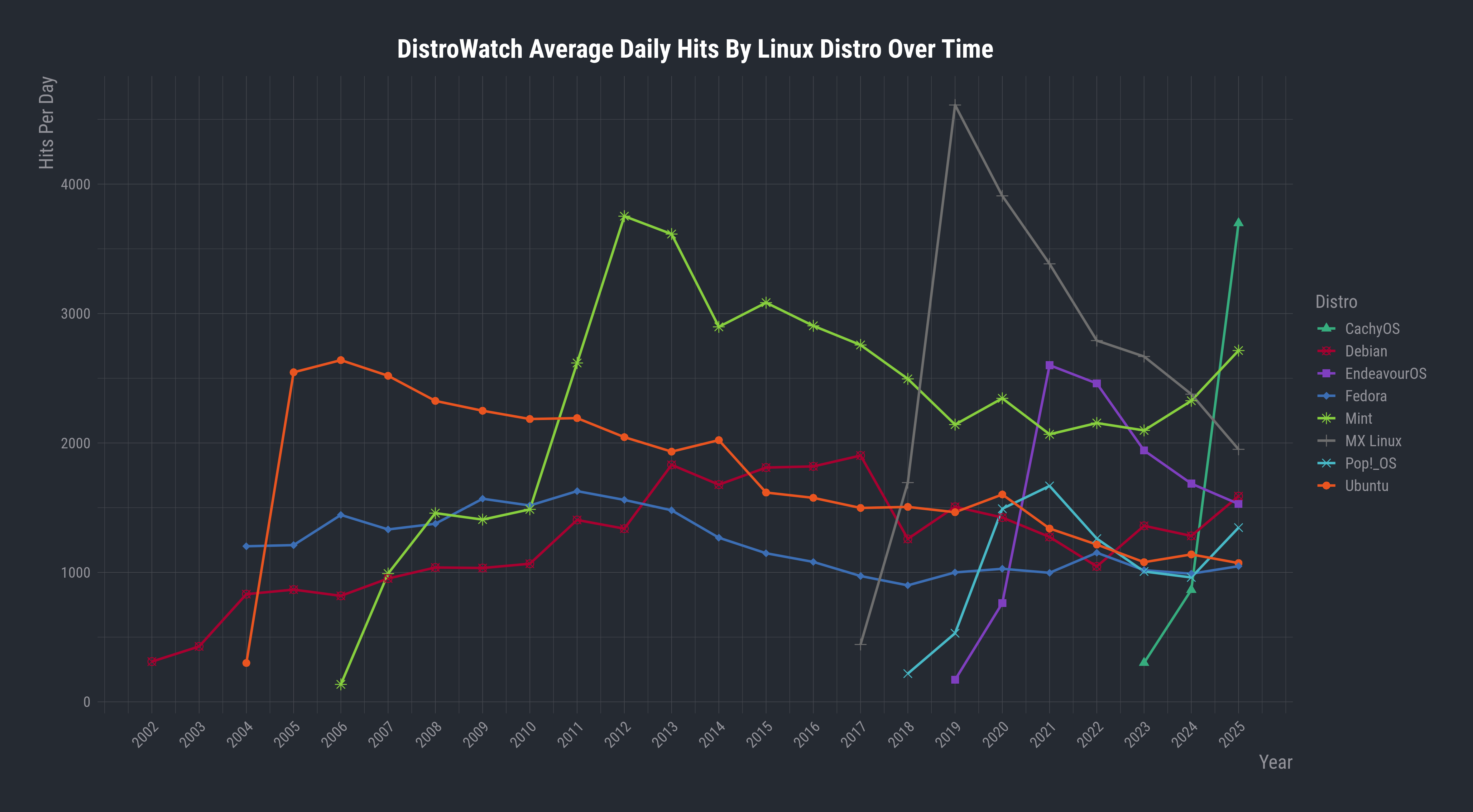
Source: DistroWatch2
The above graph shows hits per day for the most popular Linux distros, averaged over the year into a single value for each. Individual lines represent this trajectory over the course of 20+ years since 2002, though newer OSs only appear from the year they were released.
The picture tells two stories: one is the fairly chaotic “boom and bust” cycles of new distros, the other is the relative stability of traditional systems.
Mint, EndeavourOS, MX Linux and Pop!_OS have all benefited from a huge wave of excitement around their introduction followed by a significant decline (on the order of a halving) shortly afterwards. Note that Mint has established a bit of a comeback of late, currently sitting at #2 as of last year (and on the live leaderboard at the time of writing).
The newcomer CachyOS went through a meteoric rise last year that is hard to ignore, but will it suffer the same fate? Or will it become the Linux staple for the remainder of the decade and beyond?
The other substory in this chart is the one of the veterans, which show far more stable trends. Fedora has exhibited some variability over the period, but is ultimately very stable as it has, roughly speaking, as many hits in 2025 as in 2004 (modest change: -13%). Debian, on which Ubuntu is based, has on the contrary shown relatively stable growth in absolute values over the period (a whopping change of: +411%).
Sitting amongst it all is Ubuntu, which shows a steady decline in website traffic since its peak in 2006. The change may not be as sharp as the boom-and-busts of some newcomers, but the pattern is clear, having more than halved in the 20-year period (change since 2006: -59%).
This relatively raw view of hits per day can be simplified by instead looking at rankings, as shown in the graph below.
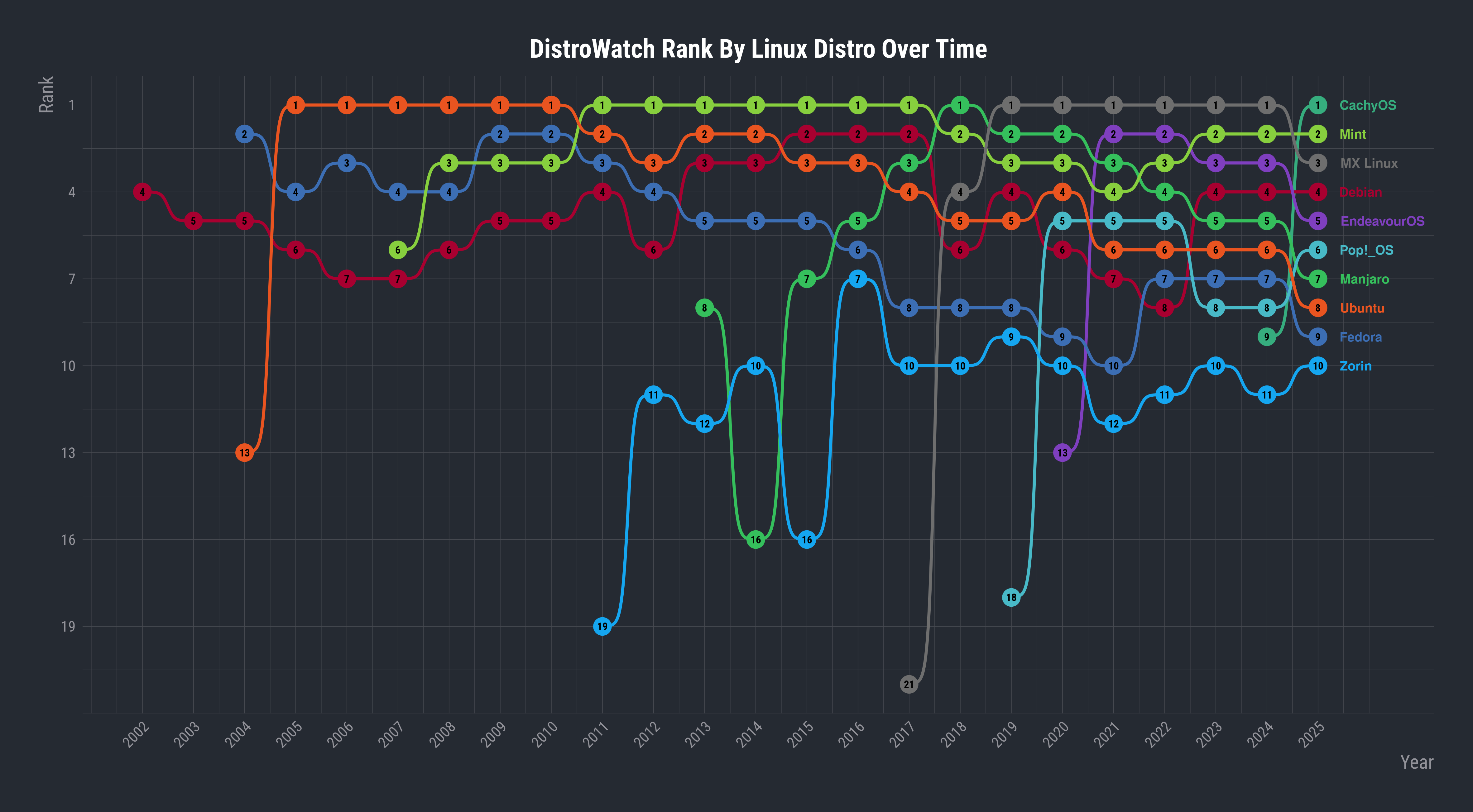
Documented through this lens are the incredible rise of distros like Pop!_OS and MX Linux, as well as the dominance of Mint throughout most of the 2010s.
We should note that these ranks are useful but can mask or magnify patterns: they are susceptible to switches even on minor changes. For example, in 2025, Ubuntu (#8) and Fedora (#9) were separated by the tiny margin of just 24, whereas the gap between CachyOS (#1) and Mint (#2) was far larger (approximately 1,000).
Also, a quirky fact is that Debian remains #4 in 2025, as it was in 2002, despite its impressive growth in daily hits (more than +400%)!
Whilst MX Linux has halved in absolute values since its peak, it is still third most popular as of last year, and therefore a serious contender if you’re looking around for a new distro.
Finally, let’s look at how the relative proportions for each distro evolve over time, using a dynamic visualization of the DistroWatch daily hits figures since 2004. Hit Play to watch the Linux landscape evolve over time.
Note: I have omitted the “Other” category from this visualization owing to the long tail of Linux distros which would unnecessarily dominate the picture (regularly accounting for more than 50% of the pie).
Why the Decline?
A few of Canonical’s own decisions didn’t help. The switch to Canonical’s own Unity desktop3 in 2011
was divisive, perhaps a step too far for plenty of long-time users who
preferred the familiar GNOME 2 layout. Many switched to Mint, others to Debian. More recently,
the push towards snap packages4 as the default delivery mechanism has been another point of friction for a
vocal part of the community, as it is a closed-source server with some performance issues.
It’s worth reiterating, though, that DistroWatch measures curiosity as much as anything else, and is therefore skewed towards distro-hoppers (which I clearly am not). A chunk of Ubuntu’s “decline” in the chart could partially be explained by attention spreading out across a healthier, more varied landscape. That’s arguably a good thing for Linux overall.
The Server Caveat
All of the above is primarily a desktop story. When it comes to server infrastructure, the backbone of the internet, Ubuntu is still very much in the frame. As of 2025, Ubuntu commands just over a third (33.9%) of the market share of enterprise Linux servers, beaten only by Red Hat (RHEL, 43.1%)5.
On Docker Hub, ubuntu is one of the most pulled base images, with cumulatively more than 1 billion pulls6
(along with debian and alpine).
New Features in 26.04
The “Resolute Raccoon” will become available later this week (on 23rd April 2026), and contains numerous noteworthy features7. Here are the key changes:
- Terminal refresh: terminal rewritten with Ptyxis, features pinned tabs for cross-session persistence.
- Linux Kernel 7.0: plenty of upgrades to support modern chips, improved large-data transfers.
- sudo-rs: Rust comes to
sudo, replacing the traditional C-based version. - GNOME 50: drops support for X11 sessions, using Wayland exclusively.
- Dev stack upgrades: such as PostgreSQL 18 and Python 3.13; Zig newly available.
- SSH: post-quantum keys will now be used by default for ensuring remote access security.
- Video: hardware-accelerated when watching/streaming video (VA-API).
- LTS: Long-Term Support version (nothing special, but will continue to receive 5 years of security patches and bug fixes).
This list isn’t the half of it, so this release packs quite a punch, which I hope will convert to a great experience. I’m glad to see the inclusion of modern dev tools (e.g. Python 3.13), and will sleep easier knowing that my SSH connections to remote servers are quantum-proof!
Note however, that 26.04 is the first that requires 6GB of RAM, which is significant! This could make older laptops suffer.
I’m also not 100% sure how I feel about password feedback under the new sudo ****.
Final Thoughts
When I adopted Ubuntu as my main operating system in 2011, it was still #2 in terms of popularity, but perhaps it was already in decline. So, was it an unlucky choice? I don’t think so.
Despite the somewhat gloomy picture the DistroWatch figures paint, I’m still very happy with my experience of Ubuntu, both as a desktop user and terminal power user. I am relatively confident that, come Thursday, the new version will be a very useful upgrade.
I intend to install Ubuntu 26.04 as soon as practically possible … but I may have a quick read into CachyOS first :)
If you’ve enjoyed reading this article, please drop a star on the supporting GitHub project page ⭐
-
A Disturbing Dialog About Ubuntu and Unity, Linux Magazine (2011) ↩︎
-
Linux Distros in September 2024: Welcome to Hyper-Fragmentation, Boiling Steam (2024) ↩︎
-
Linux Server Market Share (2026). Command Linux (Dec 2025) ↩︎
-
Ubuntu 26.04 LTS (Resolute Raccoon): New Features, Changes, and What to Know, ComputingForGeeks (2026) ↩︎